Showing posts with label Wretches & Riches. Show all posts

Saturday, 30 November 2019

The Village of Orlane

An online game running through Against the Cult of the Reptile God fizzled out fairly quickly, but not before I'd invested some prep time into it.

I didn't like the perpendicularity of the village of Orlane in the original module's map, so I scribbled my own unkeyed version for use. Hopefully I can run through the module again some time with another group.

Until then, here it the map of the village, should anyone wish to use it. I hope to get some use out of it some time in the future.

Wednesday, 20 November 2019

Die-based followers

Note: there are two variants presented here - one for Wretches & Riches and one for a more standard d20-based system like Knave. 
W M Goodes

The Objective


One of the elements in Wretches & Riches which in particular strays from traditional D&D-based rules is how the party's NPCs are handled. Since W&R makes it harder for PCs to carry around an armoury for the duration of an adventure, I especially wanted a system which which encouraged them to use followers to help bear the load. Such a system would need to make followers capable enough to be worth having, but not add too much extra information for players to manage so that combat in particular doesn't get bogged down. If possible, I wanted to carry forward the challenge facing PCs - the more hurt you are, the less effective you become.

W M Goodes
I'm a tactile-inclined person, and even when GMing theatre of the mind gameplay I will usually have coins, tokens and dice on a sheet of paper to help me picture how everyone is positioned in a room. Often this doesn't get shown to players - it's behind my (physical or virtual) screen. Over time (especially when either Roll20 or my internet connection were dragging their heels) I started using these physical avatars to represent hit points. Most minion creatures would get a number of tokens or coins stacked on top of each other, to be removed as appropriate, and tougher beasts would get a gradually reducing d20 face.

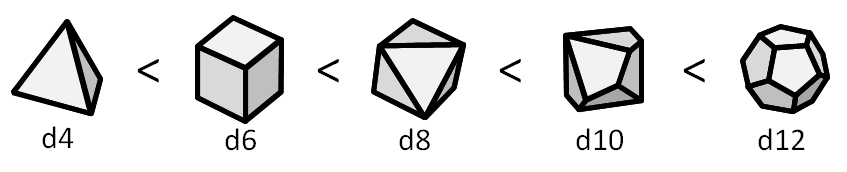
Taking a leaf out of The Black Hack's book of reducing a basic monster to a single HD figure from which you can extrapolate pretty much everything else you might need, I wanted to do the same with followers. At this point W&R had accrued die-based resources (though still with modifiers for attributes) so it wasn't an enormous leap to abstract most of a follower to a solitary die. Now I have my tokens showing me with a quick glance what die needs to be rolled.

These rules use the following die chain:


Followers in Wretches & Riches 


All followers are represented by a die size, and some skilled followers may have a list of strengths.

Any time the follower needs to make a roll, use their die - including challenging tasks, combat and morale. If the roll would fall under one of the follower's strengths, use the next die size up.

A follower is assumed to provide their own equipment relating to their strengths. For any other items, they may carry up to their max die size in slots.

If there's cause for a follower to question a PC's leadership, such as a disastrous fight or being asked to do something unusually dangerous, roll a morale check with their die. On a 1-3 they reject the PC's authority. The referee should decide if this means a simple refusal, or even potentially the follower quitting and fleeing the whole adventure.

If a follower is wounded at all, reduce their die size one step. If a d4 follower is wounded, they have been killed.

If unsure, a follower usually costs their die size in coin per day.

Followers in Knave


All followers are represented by a die size, and some skilled followers may have a list of strengths.

Any time the follower needs to make a save - including challenging tasks, combat and morale - roll a d20 and their die together, and add the result. Their die size acts as their attribute modifier. If the save would fall under one of the follower's strengths, use the next die size up.

Single roll combat variant: the follower's die is also the damage they cause in combat. If an attack of theirs hits, for damage caused use whatever their die rolled when rolling to hit.

A follower is assumed to provide their own equipment relating to their strengths. For any other items, they may carry up to their max die size in slots.

If there's cause for a follower to question a PC's leadership, such as a disastrous fight or being asked to do something unusually dangerous, roll a morale save. On a failure they reject the PC's authority. The referee should decide if this means a simple refusal, or even potentially the follower quitting and fleeing the whole adventure.

If a follower is wounded at all, reduce their die size one step. If a d4 follower is wounded, they have been killed.

If unsure, a follower usually costs their die size in coin per day.

Bookkeeping


Here is a blank follower 'sheet', and a filled out example:


Sunday, 17 November 2019

Wretches & Riches discussion

Jojiro of Dungeon Antology made some comments about Wretches & Riches on the RPG Talk server, and I felt they were worth saving from the transient Discord stream. I always appreciate someone's thoughtful comments, and if that feedback can be documented then so much the better. They will be valuable to looking back on when problem-solving.


17th Nov 2019 - Jojiro

1. One of my biggest issues with systems like ItO and Knave is that your life has no context in the bigger picture. I feel pressure to make a class system or at least some form of background system for them. That's covered in yours, albeit only with inventory and a cheeky question to the GM regarding dice checks. I like that sort of thing in general. It's also why I'm excited for Electric Bastionland.

2. Unified pass-fail mechanics. I don't actually like your particular implementation of variable dice for each stat necessarily, but I really enjoy when you know if you succeeded or failed the moment you roll, rather than needing the GM to compare it to a hidden AC or DC to be like "uhhh...gimme a sec...you hit". Having 4+ makes the game flow more smoothly. The reason I don't like your implementation necessarily is cuz it doesn't allow for granular difficulty adjustment. My favorite for that remains dice pool systems.

3. I'm a fan of lowering the amount of ability scores/attributes to under classic 6, because I find the 6 existing ones redundant, even for compatibility purposes. So any reformulation of that, I'm a fan of.

4. For similar reasons to #1, I really like the archetypal abilities, though I will say that the 10-week time seems a tad long and unrealistic, even for something like a journeyman-level apprenticeship, much less just learning to pack things more tightly.

5. I'm a big fan of word magic systems. I've yet to find one I like enough to steal from, but each time I see one with recombined words I'm like "this is neatly modular and I feel like eventually I'll find one I want to steal". The big thing stopping me is usually the desire to have magic be simultaneously a "predictable toolbox" and also "succinct and concise" and also "intensely flavorful". And those 3 priorities clash hugely.

6. This is the thing I'm the biggest fan of: single die hirelings. In fact, this idea is only doable because you do variable dice, and have defined checks and tests the way you have. It's not quite possible in most of the systems I've hacked or made, but I really really am looking for ways to steal this precise mechanic, because it's so elegant, and makes hirelings so much easier to handle. I'd go so far as to say that looking at this, I almost felt as if the system was geared around making hirelings convenient, because I really do find this brilliant.
Like, the whole hireling, from health to morale to skills to attacks, is defined by a single die. That's just brilliant to me.


My reponse:

Thanks for the thoughts, and I too am keenly anticipating Electric Bastionland!

I did until this current iteration try to keep the d20 in, but in the end it just felt out of place. Since that observation came from diehard 5e fans, I took it to heart. Otherwise I was thinking of having a d20 + modifer opposed rolls, which is pretty much what 5e does except for declaring that one side has passively rolled a 10.

I did consider multiple dice for attributes but decided against in the end for the sake of simplicity. Pulp Alley - a miniatures 'war'game (more of an action game) - does do that though, keeping the 4+ rule and going by numbers of successes to overcome challenges. I recommend checking it out - there's a free quickstart PDF, and the author has a large number of Youtube actual plays and tutorials.

The moment when it clicked that I could have four symmetrical attributes all with an 'i' as the second letter was a truly joyous occasion, and now I can barely look at a retroclone without thinking about using this handy quad which nicely embody the four base classes of most clones (DIS-cleric, MIG-fighter, NIM-thief, WIT-magic user).

Yeah, timing-wise I suspect levelling requirements will change, and that's one of the main things I'm looking at in current playtests. I do like the idea that a DIS check might allow the studious to learn faster than their peers, since I think it's probably the 'weaker' of the attributes at the moment, but it's up in the air. I am keen to keep the mentor side of it in though and some time invested to build up plot hooks in the world. My biggest gripe with many OSR rulesets is probably the Vancian magic system. I love any alternative take. My aim with this one is flexibility while keeping a somewhat Pratchett-esque tone. One of my favourite Discworld quotes is this:

Not doing any magic at all was the chief task of wizards – not ‘not doing magic’ because they couldn’t do magic, but not doing magic when they could and didn’t. Any ignorant fool can fail to turn someone else into a frog. You have to be clever to refrain from doing it when you know how easy it is. There were places in the world commemorating those times when wizards hadn’t been quite as clever as that, and on many of them the grass would never grow again.

If I didn't want to try and fit this game into an A5 booklet, each spread would start with a Pratchett quote.

I never got round to playtesting this, but one possibility I thought about for hirelings as die-based characters was rolling both their die and a d20, adding them together. It would essentially mirror 5e's proficiency die alternative in the DMG, and whatever the hireling die rolled could be used as a damage die in a combat scenario, thus keeping their attacks to a single roll.

Saturday, 16 November 2019

Wretches & Riches - version 0.41

This is the homebrew game I've been putting friends and family through. It started off as a GLOG hack with gradually more and more Knave and Black Hack elements introduced, then cut out, then sewn back in again. Then Into The Odd reared its head, and apparently it's taken on some Savage Worlds developments too. I've never read Savage Worlds, so others will be in a better position to compare them.

I've never found reading rulebooks easy. The information just doesn't get absorbed efficiently, and I really struggle to translate what I read to what the process might look like in action at the (physical or virtual) table. I wanted to a game which might be a bit kinder to those of us less academically-inclined folks. Pictures, diagrams and examples aplenty. Minimal modifiers.

Old School Compatibility

I wanted to keep it compatible with all the D&D modules out there so it couldn't stray too far from that framework, but it certainly pushes the boundaries. It's various versions have been through the Tomb of the Serpent Kings, the Stygian Library, Fever Swamp and various Trilemma adventures, and its currently running through Against the Cult of the Reptile God. From a GM's perspective, I'd say it has been simple enough to convert things, particularly monsters, on the fly.

Key points:
  • Attributes are dice, not modifiers - ranging from d4 to a max of d12. Roll 3+ to succeed a check. Don't roll if it's too easy or impossible. Roll with advantage or disadvantage if there needs to be an adjustment made for difficulty. Opposed rolls if another party is involved (traps and the like can be interpreted to be another party).

    This means there's a tactile element to go with a character's attribute improvement.
     
  • Four attributes rather than six: Might, Nimbleness, Discipline and Wits. Two physical and two mental. No charisma stat - if a player wants to roll during a conversation, the attribute is determined by the character's approach to the conversation (Might for intimidating, Wits to be charming, etc).
     
  • Luck which is also a die - the player can choose to roll it with any other attribute die. Essentially players can choose to roll with Advantage, but if the Luck die rolls 1-3, it drops down a size.
     
  • Inventory as HP - the more you get hit, the less you can carry and the less effective you are. Characters have twice as many burden slots as their highest attribute die, and these are used for noting equipment, spells and archetypal abilities. Each point of damage taken fills up a slot with an Encumbrance - any contents must be dropped or rendered unusable. If all slots are filled with Encumbrances, the character rolls on the Death / Reprieve table.
     
  • Opposed combat rolls with both participants rolling a single die depending on their weapon. Highest roll inflicts the difference in damage (except in ranged combat - if the defender wins, they've just avoided damage). Armour reduces this damage to a minimum of 1. Shields don't reduce damage, but reduce the size of the opponent's die. If a character uses a weapon die higher than their Might die, then they roll at disadvantage. Allies can roll their dice together and take the sum for their side.
     
  • Powerful but dangerous and unreliable magic where the player chooses how many magic dice to roll (equal size to the character's Wits die), and the number that roll 4+ is the level at which the spell is cast. Doubles reduce the Wits die and trebles cause a magical mishap which permanently takes up a burden slot (until the character performs a quest for a wizard or something like that).

    I like the idea that a character could decide to go out with a bang and cast at a level which, while dooming themselves, might well eliminate an army of opponents.
     
  • Die-based hirelings for simple book keeping - just need to record their die, inventory (equal to die size) and what they're good at. If they need to do anything, roll their die as the appropriate attribute. If it's an area of expertise, roll the next die size up (if they need to roll at all). Getting injured drops their die size down. Use their die for any morale rolls.
Format-wise, it prints nicely as an A5 booklet. The first half accounts for character creation, and the second half encompasses the basic rules. Open up the middle page spread and that's the start of the rules, covering the main points of controlling a character.

Art from W M Goodes' work in the public domain, taken from A Comic Guide to the English and A Comic Guide to the Greeks. It captures the sort of tone I like in my games, and there's a load of good stuff. Any spare white space in further Wretches & Riches work is definitely going to get filled.

PDF of the game book is available here.
Google Sheets version of the character sheet is available here.